
Learn More about Charleston’s “Silent Sentinel”
Castle Pinckney, constructed c. 1809, has a fascinating history that precedes Fort Sumter, whose construction began in 1829 but was unfinished when the War Between the States began in 1861. The fort also has an interesting history following the war. To fully appreciate the history of Castle Pinckney, Charleston’s “Silent Sentinel,” you need to know more.
Below is a great place to start. You’ll find much more on Castle Pinckney in this website’s Archives. Visit The Shute’s Folly Beacon to learn about activities, including archaeological projects, that will be conducted once the Castle Pinckney Historical Preservation Society launches its effort to save the fort.

Fourteen Historical Facts about Castle Pinckney
1). Castle Pinckney was constructed as a state-of-the-art seacoast fortress on the eve of the War of 1812.
2). The masonry fort, with its innovative horseshoe design, was part of the nation’s “second system” of coastal fortifications.
3). The structure was built on Shute’s Folly, a marshy island in the center of Charleston Harbor, and designed to protect Charleston from a naval attack.
4). Castle Pinckney’s strategic location allowed the fort to command Charleston and the busy wharves along East Bay Street facing the Cooper River. This made the fort an important chess piece in the secession turmoil of 1832 and 1850, and in the months leading up to the bombardment of Fort Sumter on Apr. 12, 1861. More
“Castle Pinckney: Silent Sentinel in Charleston Harbor”
By Suzannah Smith Miles
The Post & Courier, Moultrie News
Nov. 27, 2012, Updated Aug. 20, 2020
Reprinted with Permission
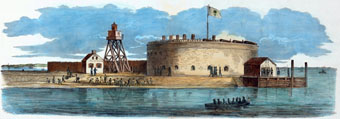
It is the “other” island in Charleston harbor, the one closest to peninsula Charleston and easily seen from the Battery, often mistaken by visitors for Fort Sumter. Although not much remains of Castle Pinckney proper and its thick brick walls are now crumbling amidst a tangle of wild vegetation, the site has a long and impressive history. More
Holding CHARLESTON by the Bridle: Castle Pinckney and the Civil War
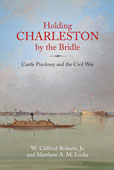
Holding Charleston by the Bridle: Castle Pinckney and the Civil War, by W. Clifford Roberts, Jr. and Matthew A. M. Locke, is the first book on the subject. The authors, relying on extensive primary research and archaeological evidence, tell the full story of Castle Pinckney. They explain everything, from the fort’s innovative design as part of America’s “Second System” of coastal fortifications to the modern challenges of preserving its weathered brick walls against rising sea levels. Given its importance to America’s history, this book is long overdue. Considering current efforts to protect and restore the historic fort, it is a must-read. For Sale Online